This week we deleted a 29,000-token prompt from our AI, and the answers got better.
For months, every rule we had ever learned about how to answer a real estate question got stuffed into the front of the model’s context. 233 handwritten notes, injected on every single query. It felt like intelligence. It was actually a hoarder’s closet. The model spent more effort reading our instructions than reading the data. So we tore it out and replaced it with 20 curated canon rules that always run, plus a retrieval layer that pulls in only the notes relevant to the question being asked. Fewer words in, sharper answers out.
That one decision is the whole thesis of the week, so let me say it plainly: the model is the cheapest, most replaceable part of what we’re building. The intelligence lives somewhere else. It lives in the graph, the ontology, and the loop. Here’s what we shipped to make that true.

The brain that grades its own homework
Onyx, our intelligence engine, now has one shared brain that every part of the company reads from and writes to. Before this week, we had three brains learning in isolation. The voice rules the article writer used never taught the search engine anything. The real questions people asked Onyx never steered what we wrote about. Three silos, zero compounding.

Now every human edit is a lesson. When a draft gets written by the machine and then fixed by a person before it is published, we diff the two versions, extract the generalizable rule behind the fix, and stage it for review. Same for the social graphics: edit a caption, and the system learns the caption rule. Approve it once, and it applies everywhere, forever. We also gave the brain a gardener, a weekly pass that finds duplicate and redundant rules and merges them, so the thing prunes itself instead of bloating back into that 29,000-token closet.
The point is not that the AI writes. Lots of things write. The point is that the writing gets better in a direction that is ours, on a corpus that is ours, and the compounding accrues to us and not to whatever model vendor we happen to be renting this quarter.
Deep mode, or the difference between a fact and a brief
Most AI searches give you a fact. Ask a normal question, get a quick grounded answer. That is our free tier, and it is genuinely useful.
But the questions that actually matter in this industry are not lookups.
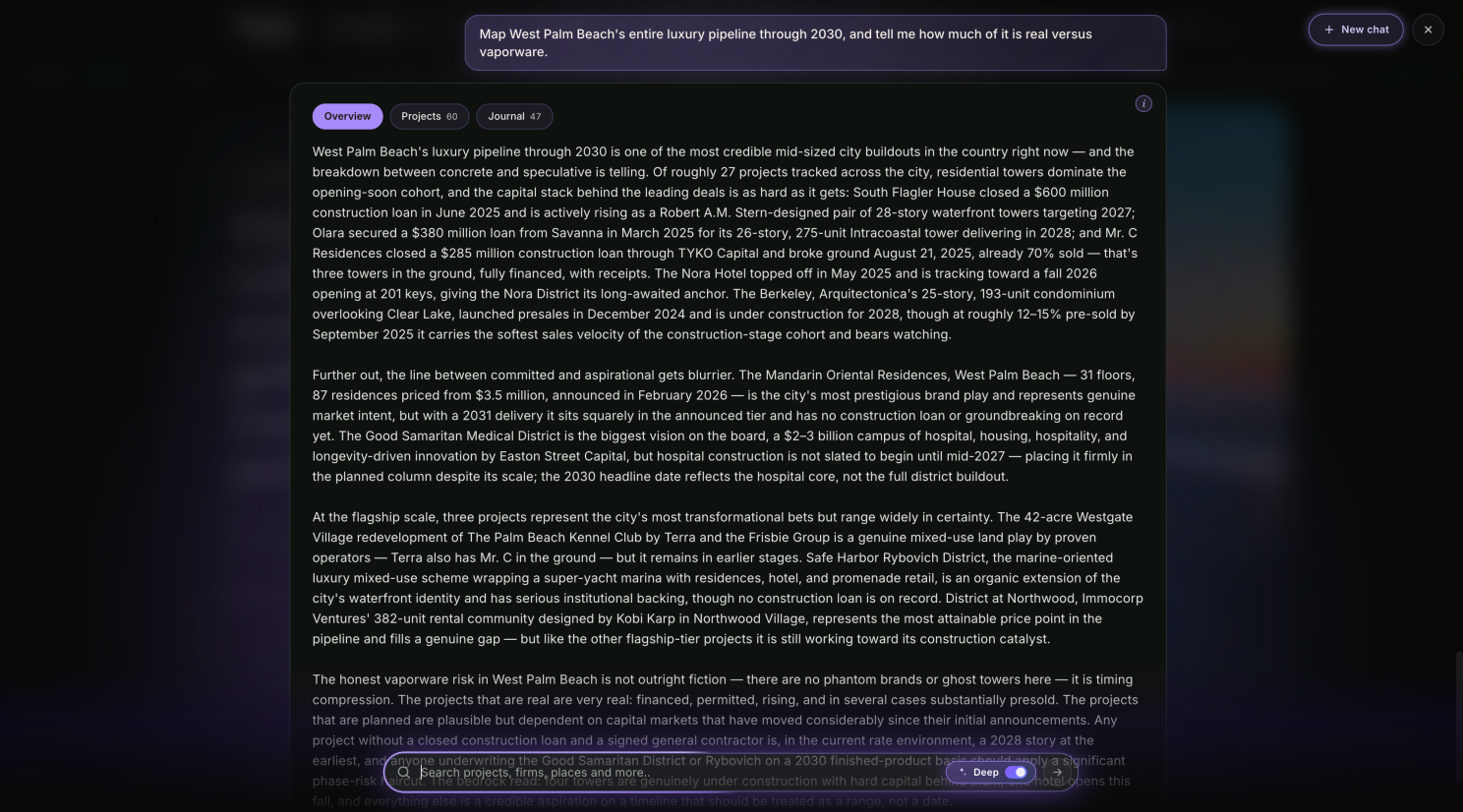
- Map West Palm Beach’s entire luxury pipeline through 2030, and tell me how much of it is real versus vaporware.
- Where is capital rotating now that Miami and Nashville are crowded, and which developers are already there?
- Which branded-residence flag (Aston Martin, Bentley, Ritz, Waldorf) is expanding fastest, and what market are they racing into next?
- Compare Miami’s Edgewater and West Palm Beach’s waterfront: who’s building more, taller, and faster right now?
- Which architects are quietly shaping most of the next decade of South Florida’s skyline?
- Give me the full development story of one neighborhood: every project, its status, who’s behind it, and how it reshapes the area.
Those are not facts you retrieve; they are briefs you synthesize, and synthesis needs the whole picture in view at once.
So we built Deep mode. Flip the toggle and TMW Intelligence stops doing fast lookups and instead reasons across a hundred-plus matched projects from the verified database at the same time, holding all of it in wide context, cross-referencing timelines and developers and delivery track records before it answers. It is slower on purpose. What comes back is not a sentence; it is the kind of memo an analyst would spend an afternoon assembling.
Here is the part that ties back to the whole thesis. The power of Deep mode is not the model. It is the wide context, plus the verified graph, plus the ontology the model reasons over, the encoded logic of how this industry actually thinks. That “biggest” means gross floor area, not unit count. That a project is announced is not a project delivered. A giant general-purpose model with no database will hand you a confident, beautiful, wrong answer. Deep mode hands you a grounded one, because it is reasoning over facts we verified and rules we wrote.
And because the intelligence is our data and not the model, we get to be economical about it. Deep runs on the model whose entire value is holding a lot in context, which costs us about 16 cents a query instead of the 53 a heavier writer model would. We cap it so it stays sharp rather than abused. It is a Pro feature, and honestly, it is the first thing I would point a serious real estate person at.

You can just go use it
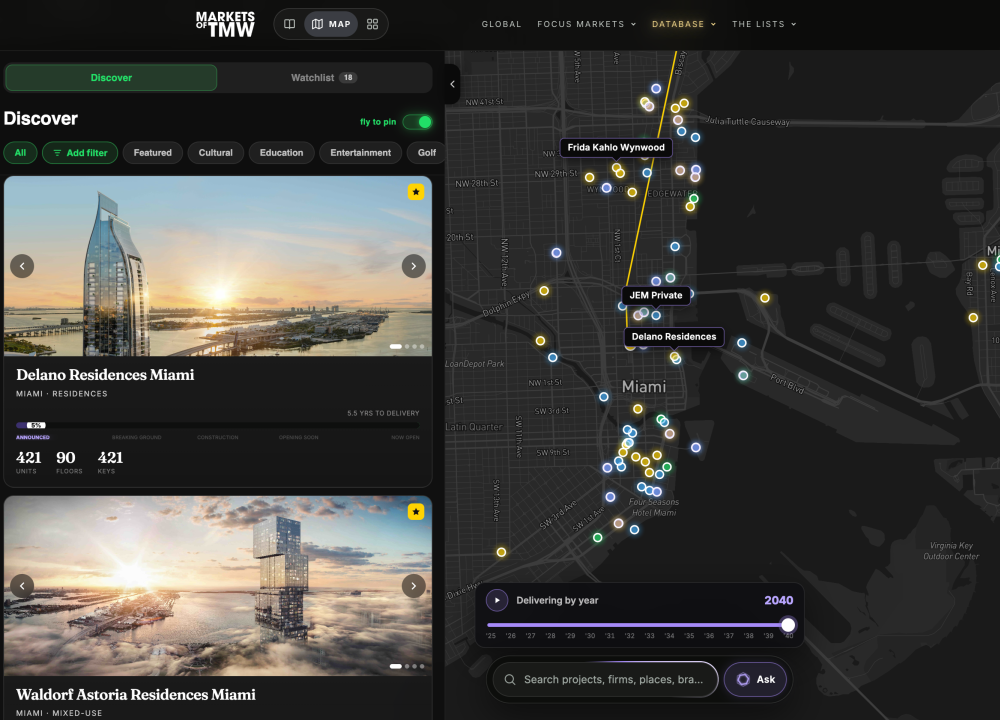
None of this is a private demo. The journal, atlas, and map are all live. Anyone can open it, search across 1,000+ verified projects, watch a city’s skyline fill in year by year, and ask Onyx a question in plain English right now. That everyday layer is free.
TMW Pro is where it opens all the way up. Deep mode, the full dossier on every project, the timeline, our intelligence read on where a development is really headed. We built the free layer to be genuinely good and the Pro layer to be the thing you stop wanting to work without. We also run all of it on our own infrastructure now, our own database, our own tracking, our own pipes, which is a boring sentence that mostly means it is fast and the numbers are real. If you follow luxury real estate in our markets, it is worth ten minutes of poking around.
What this compounds toward
The through-line of the week is one idea. The model is rented and getting cheaper by the month. What we own is a verified database of 1,000+ projects, an ontology that encodes how this industry actually reasons, and a loop that gets smarter every time someone touches the work.