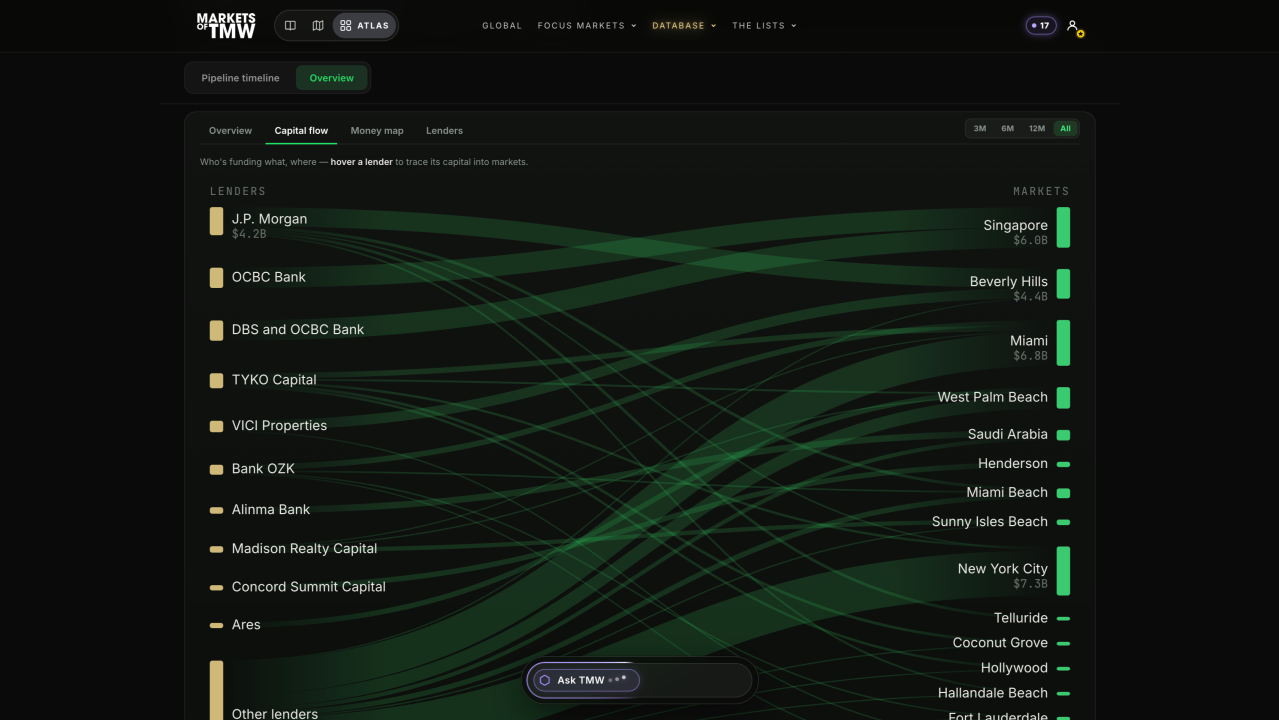
There was about $67 billion sitting inside our own database this week that we could not query.
It was all there. Roughly 169 financing events across 64 markets, the loan amounts, the lenders behind them. But it was trapped as prose, one sentence buried in a press release we had logged as a milestone. Our database knew a tower had closed on construction financing. It did not know that the loan was $340 million and that Bank OZK or Madison Realty Capital wrote it, because that fact was a phrase in a note, not a number in a field. So we could show you the concrete. We could not show you the capital.
Last week, I argued that the intelligence in what we build does not live in the model, it lives in the graph, the ontology, and the loop. This week was about making the graph deeper. Here is what we shipped.
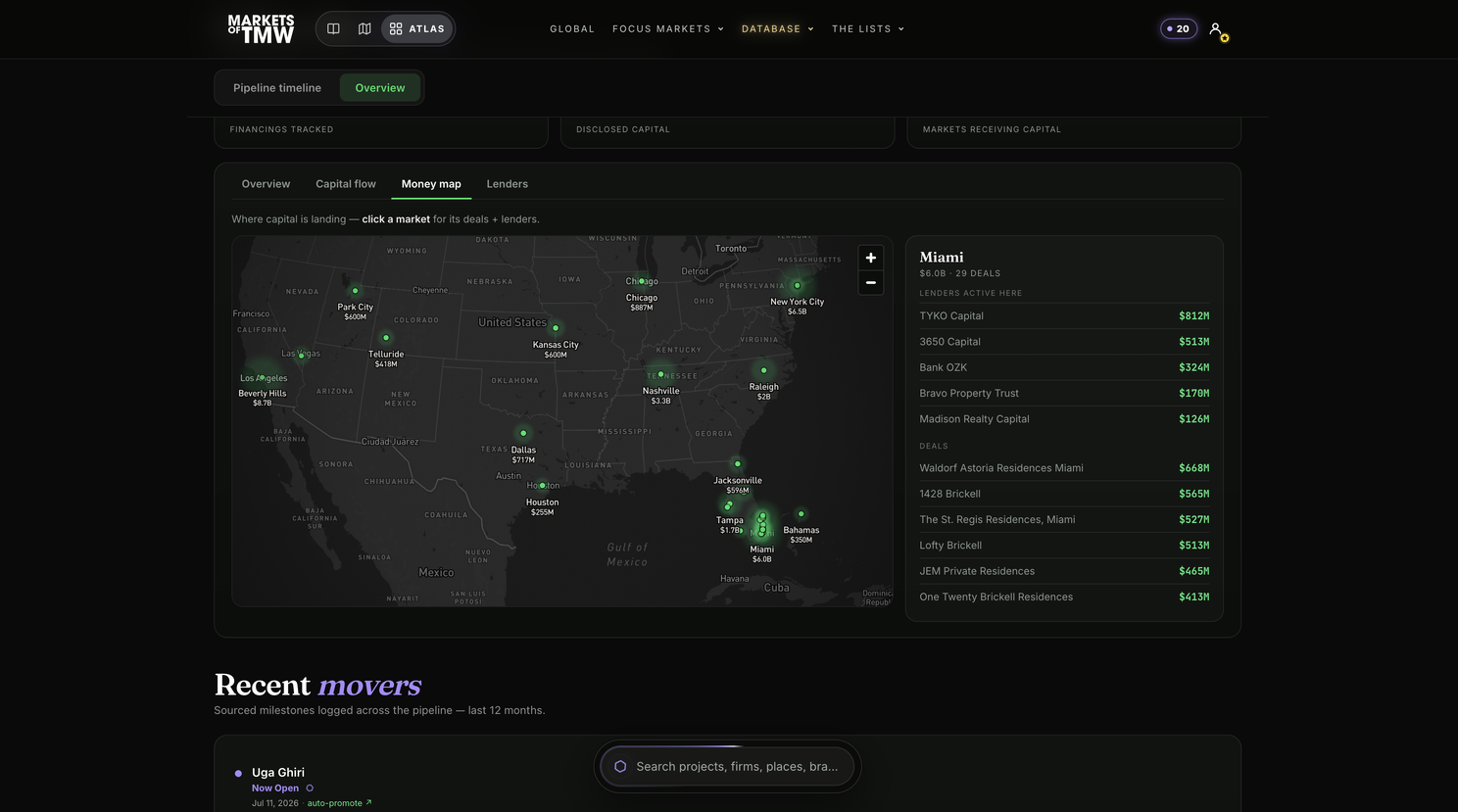
Follow the money
A development press release is very good at telling you what is being built and almost silent on who is paying for it. That is not an accident. The financing is the part the real estate and investor market actually cares about and the part the public and news feed decides not to lead with to better market towards consumers.
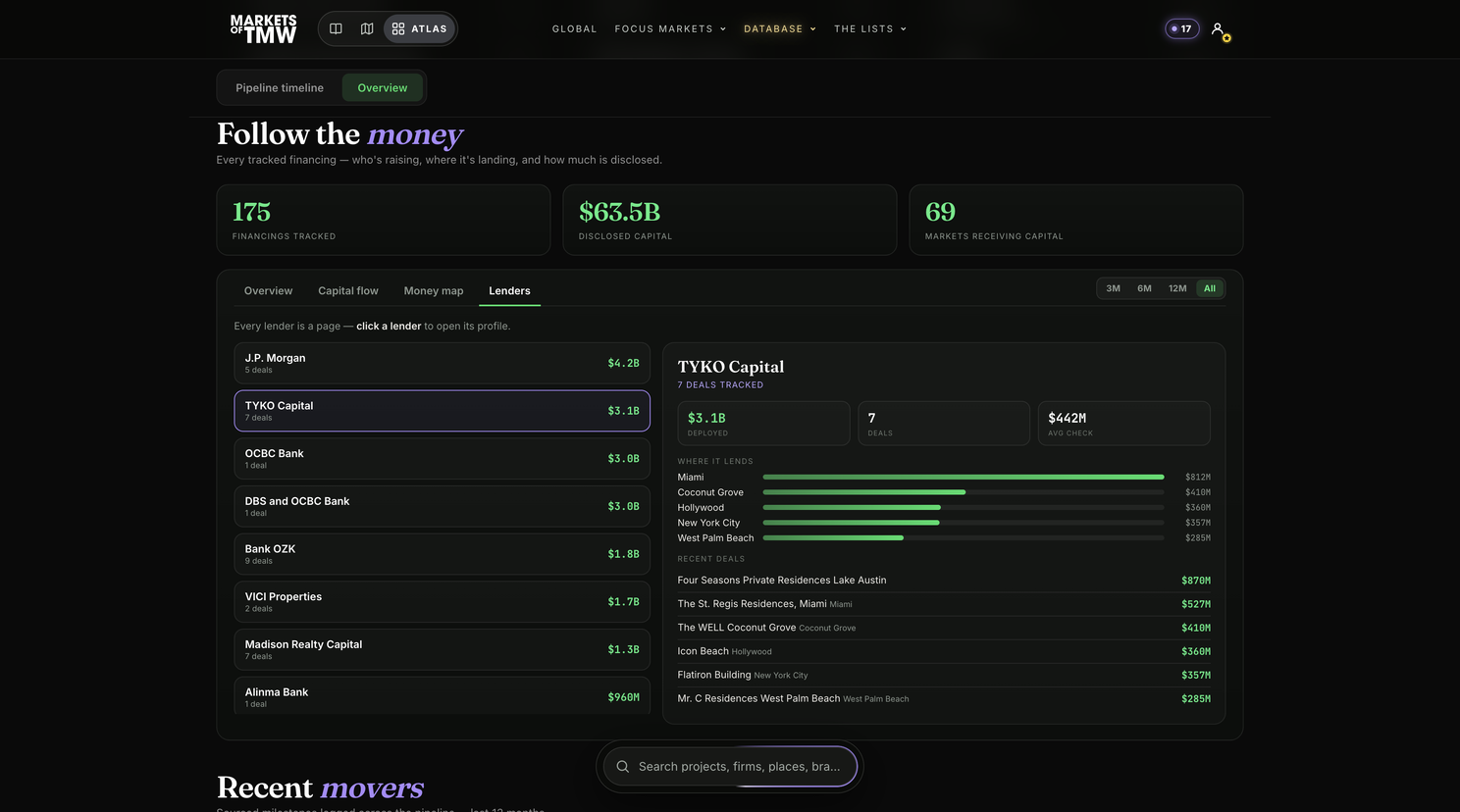
So we taught the pipeline to read it. Every time our nightly sweep logs a financing milestone now, it captures two things it used to drop on the floor: the loan amount and the lender. And we went back and starting mining the history too, parsing amounts and lender names out of the notes we already had, backfilling hundreds of deals with a real dollar figure. The first version of this tried to parse the money out of the source URLs, which was clever and found exactly one figure in the entire database, so we threw it out and parsed the note itself instead. The boring approach won, which is usually how it goes.
Here is why this matters more than it looks. The verified pipeline of 1,000+ projects was already the moat. But a pipeline tells you what is rising. Following the money tells you what is real. Capital is the earliest and most honest signal in this business. A project with a construction loan closed is a different animal than a project with a rendering and a prayer, and now the database knows the difference, at the level of dollars and names. We surfaced the first slice of it as a “Follow the Money” module on the Atlas and the homepage. It is the pipeline, but for capital instead of concrete.
Onyx stopped waiting to be asked
Last week, we shipped Deep mode, the Pro layer that reasons across a hundred-plus projects to answer the questions that are briefs, not lookups. That was still a thing you had to go ask.
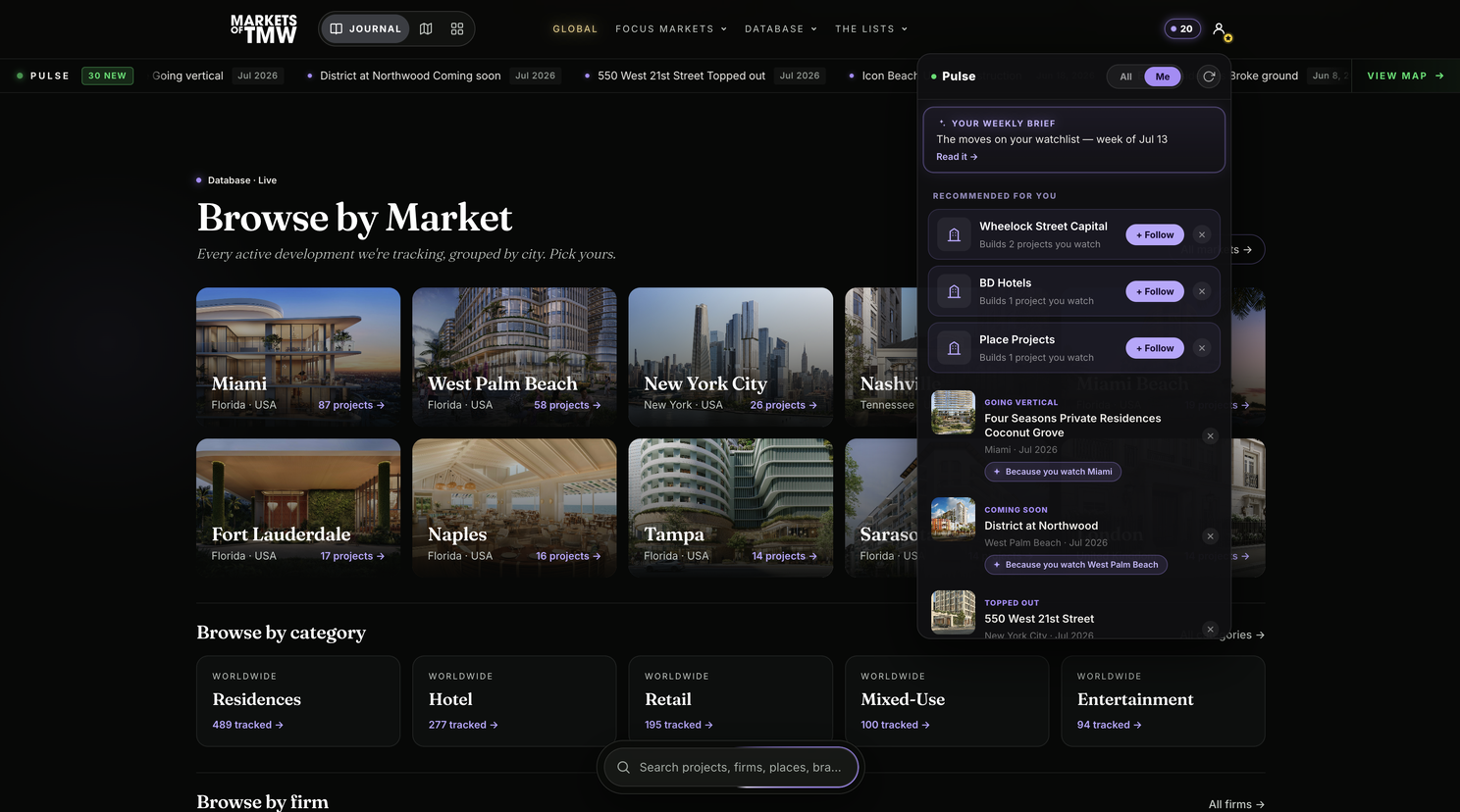
This week Onyx started answering before you ask. We shipped the weekly Brief, a running read on your specific beat, the markets, firms, and projects you follow, assembled into what moved this week and pinned as a card every Friday. You do not query it. It arrives. The watchlist that used to be a static list of things you saved grew up into something that hunts while you sleep and hands you the results on Monday morning.
The shift here is too small to describe and too large in practice. Reactive intelligence answers well. Proactive intelligence changes what you pay attention to. The most valuable thing an analyst does is not answer your question, but tell you the thing you did not know to ask about. That is the direction the Brief points, and it is the direction everything we build is walking.
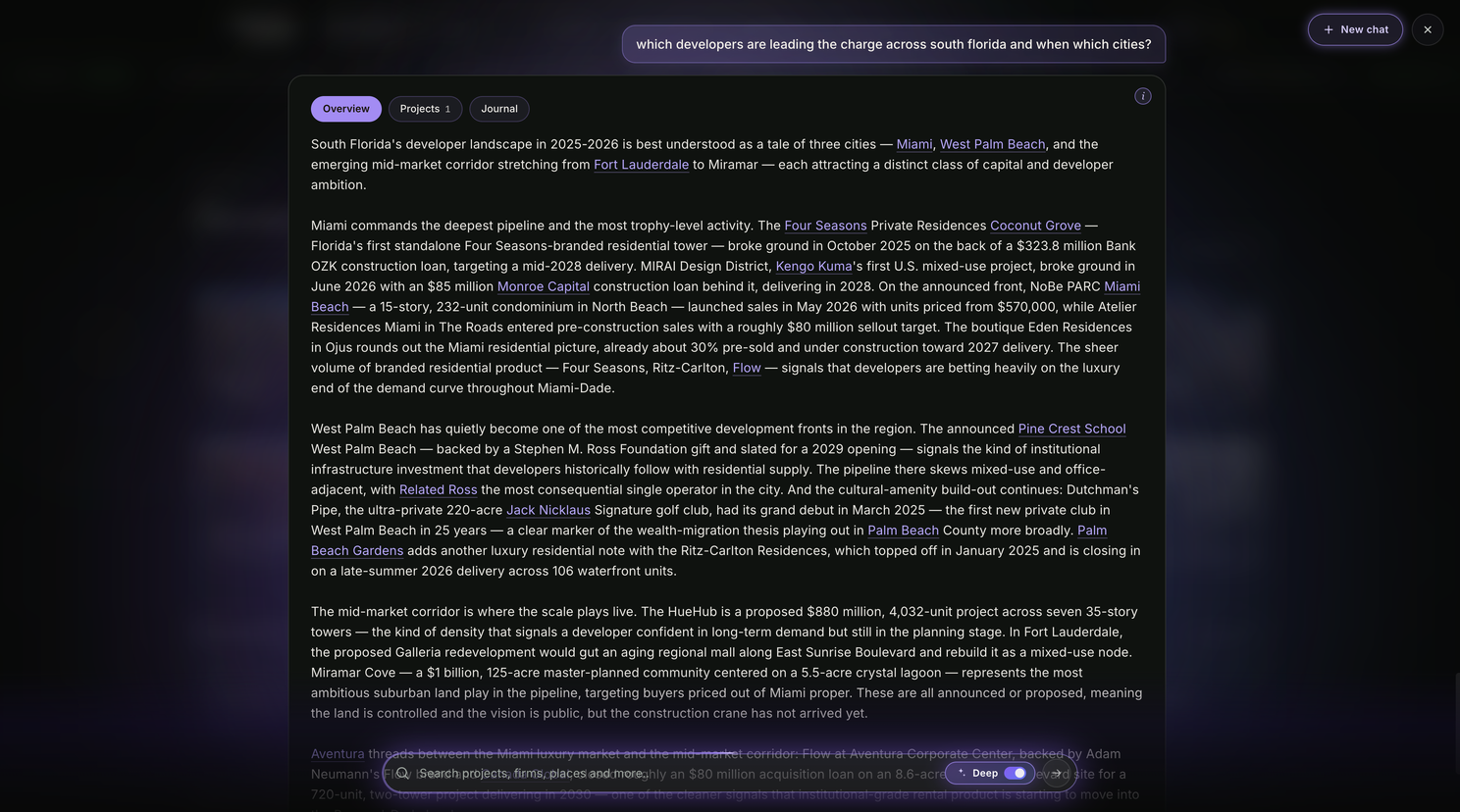
Every answer is a door now
The last piece is the least glamorous and the one I like most. Onyx answers used to be dead ends. Beautiful paragraphs, and then nothing, a wall of text you had to copy a name out of and paste into a new search.
Now every firm and every market inside an answer is a live link deeper into the database. Ask about a developer, and the answer lists every market they are in, not just their home city, each one clickable. Ask a country-level question, China and twenty others that used to return a blank, and it resolves.
An answer that dead-ends is a lookup. An answer you can walk into is a graph. We spent the week turning the first into the second.
We also shipped a pre-generated thumbnail system to speed up image loads and then deleted it 48 hours later when it added more moving parts than it saved. Owning the whole stack means we get to make that call and unmake it in two days without asking anyone. That freedom is worth more than the thumbnails were.
What this compounds toward
None of this is a private demo. The map, the Atlas, and Onyx are live at www.oftmw.com and the everyday layer is free, so you can open it right now, watch a city’s skyline fill in year by year, and ask a question in plain English. TMW Pro is where it opens all the way up: Deep mode, the full dossier on every project, the weekly Brief on your beat, and the capital picture underneath it all. If you follow luxury real estate, it is worth ten minutes of poking around.
The through-line of the week is the same argument as last week, one step further along. The model is rented and getting cheaper by the month. What we own is a verified database of 1,000+ projects that now follows the money, an intelligence engine that comes to you instead of waiting to be asked, and answers that are doors instead of dead ends. The model is the cheapest part. Everything that compounds is ours.